


A fishing trip forgives nothing. When a trawler sails for five days, every hour alongside is paid for twice: in fuel burned for nothing and in catch never landed. Revenue rides on a weather window, a quota and a market price that move every day. A winch failure on a Tuesday morning is not a line in a monthly report — it is a blank trip, a share-paid crew coming home with nothing, and a repair slot to rebook behind everyone else.
Maintenance on a fishing vessel therefore looks like nothing else in the industry. It is carried out by small, multi-skilled crews, in one of the most corrosive environments afloat, on equipment that runs continuously — deck hydraulics, refrigeration plant, shaft line — and within intervention windows measured in hours rather than days. On top of that comes a constraint every fishing operator knows: dependence on a handful of port workshops, saturated at exactly the moment the whole fleet comes in.
Well-designed fishing vessel maintenance software is not another layer of paperwork. It is the way to turn maintenance you suffer into maintenance you decide: knowing what must be done before something breaks, having the spare on board or on order in time, proving the vessel is compliant, and building a technical record that will be worth money on resale or when financing is discussed.
What makes fishing vessel maintenance different
Short trips, permanent economic pressure
Rotations are short — a few days inshore, a few weeks in distant-water fisheries — and the vessel sails again as soon as the hold is emptied and bunkers are taken. The real technical window, when the vessel is alongside, the crew available and the workshop reachable, is narrow and unpredictable. Hence a simple rule: a maintenance plan that ignores the operating calendar will never be followed. Jobs must be aligned with downtime that already exists — landing, weekend stop, seasonal lay-up, annual drydocking — and not the other way round. Software that is genuinely useful in fishing will group jobs by downtime window rather than simply stack them by due date.
Small, multi-skilled, share-paid crews
On a netter or an inshore trawler there is no engine department: there is a skipper, an engineer who is also a deckhand, and crew who maintain equipment between hauls. Technical competence is there, often excellent and highly practical, but the time to formalise it is not — and with share-based pay, every administrative hour is an unproductive hour for the crew.
The consequence for tool selection is blunt: mobile entry in a few taps, with photos, and above all full offline operation. Offshore, connectivity is unreliable; software that demands a permanent connection will simply not be used. That is a knock-out criterion, alongside those set out in our guide to the 10 criteria for choosing maintenance software.
One of the most corrosive environments afloat
Constant spray, permanently wet decks, brine, ice, organic matter, high-pressure washing, aggressive cleaning products and violent thermal cycling around the refrigeration plant: deck electrical enclosures, connectors, cylinder rods, winch bearings and hull penetrations take punishment you will not see on a passenger ship. Manufacturer intervals, written for a clean industrial duty, are therefore frequently too long in fishing. A greasing schedule recalibrated on what the crew actually observes beats a theoretical schedule followed to the letter — which is precisely the point of a properly maintained equipment register that keeps failure history and lets you adjust intervals that are demonstrably wrong.
Limited capability on board, dependence on port workshops
The onboard workshop is usually a bench, a toolbox, a welding set and a few common spares. Anything beyond that — rewinding an electric motor, reconditioning a cylinder, line-boring a bearing, refrigerant work, shaft alignment checks — goes to a shore contractor, and in most fishing ports those contractors can be counted on one hand. The scarce resource is therefore not only the part: it is the workshop slot. Anticipating a job three weeks out lets you book it; discovering it that morning means waiting. Three to six months of visibility on technical due dates changes the relationship with port workshops, and often the price negotiated.
The safety framework for fishing: what changes in 2027
Unlike merchant shipping, long governed by SOLAS and the ISM Code, fishing spent decades under an incomplete international framework. The Torremolinos International Convention for the Safety of Fishing Vessels (1977) and its 1993 Protocol never met their conditions for entry into force. It is the 2012 Cape Town Agreement, adopted under the auspices of the IMO, that updates, amends and replaces those instruments.
It sets minimum requirements for design, construction, equipment, stability, fire protection, life-saving appliances and radiocommunications for fishing vessels of 24 metres in length and over. Entry into force was conditional on a precise threshold: at least 22 States representing 3,600 fishing vessels of 24 metres and over operating on the high seas. That threshold has now been passed, and the Cape Town Agreement will enter into force on 24 February 2027. The compliance horizon is therefore dated, with sharper expectations around traceability of surveys, safety equipment and certificates.
On the human side, the STCW-F Convention (Standards of Training, Certification and Watchkeeping for Fishing Vessel Personnel), adopted in 1995, governs the qualifications of fishing crews — a separate instrument from the STCW Convention applying to merchant seafarers. The ILO Work in Fishing Convention (C188) completes the picture on living and working conditions on board, medical fitness and accommodation. Beyond these, individual Flag States impose their own survey regimes, safety certificates and periodic inspections, typically differentiated by vessel length.
Whatever the flag, the common thread is identical: what is not recorded is not deemed done. An inspection does not judge your maintenance, it judges the evidence of your maintenance. And it is worth stating plainly: fishing remains one of the most dangerous occupations in the world, with occupational fatality levels unmatched elsewhere in the maritime sector. The reliability of a winch is not only a productivity question — it is a question of lives.
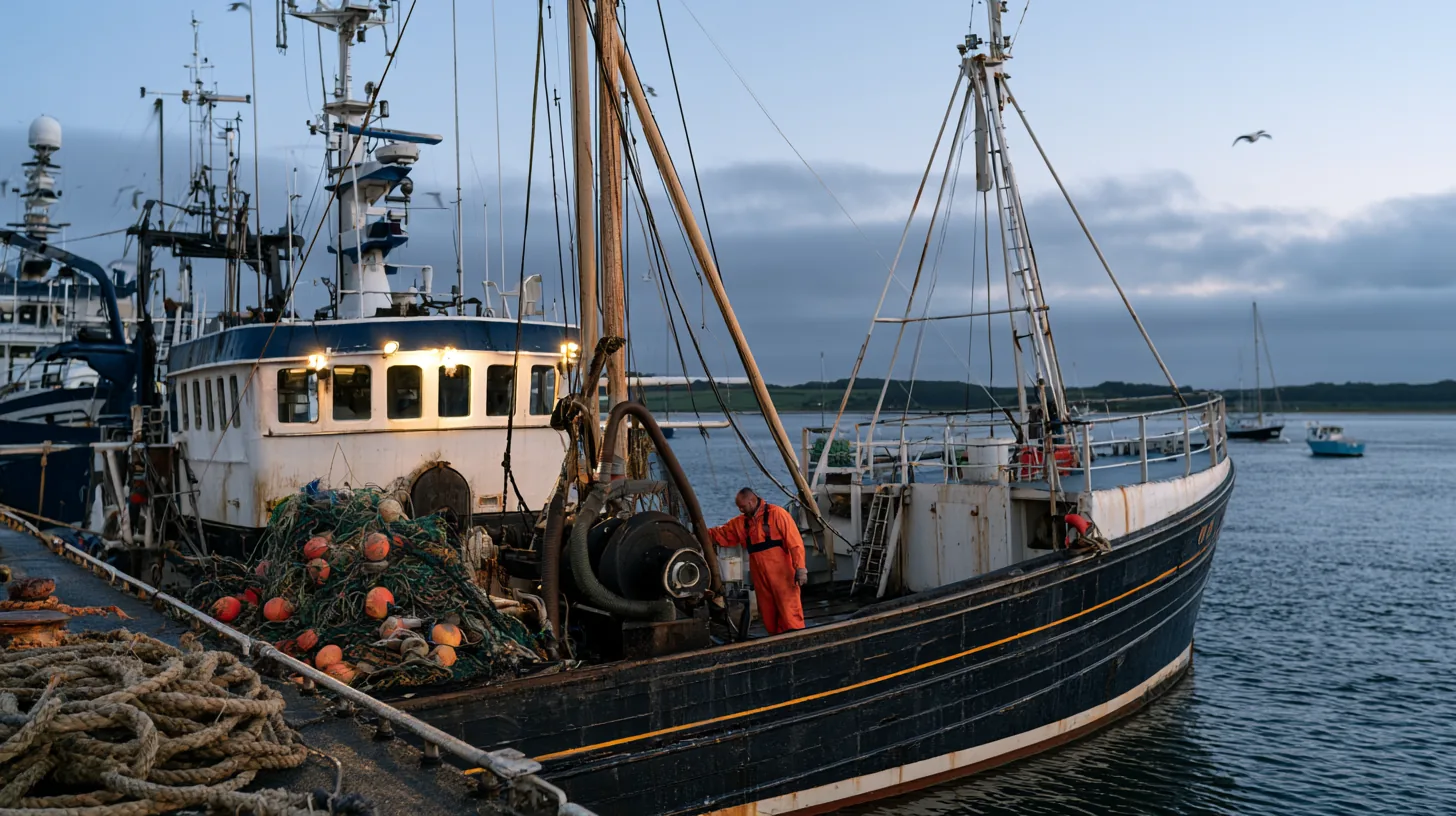
Critical equipment on a fishing vessel
In fishing, criticality is measured against one test: does the failure stop the trip or put the crew at risk? The hierarchy below holds on almost every unit.
Propulsion and shaft line
Main engine, gearbox, shaft line, stern gland, propeller and, where fitted, bow thruster. A failure here means a cancelled trip and possibly a tow. Monitoring is conventional but often skipped for lack of time: oil analysis, temperatures and pressures, abnormal vibration and noise, bearing clearance, anodes, and above all running hours. Driving tasks from hour counters rather than the calendar is decisive here: a vessel that logged 4,200 hours in a year does not have the same needs as one that logged 1,800.
Winches, net drums and deck hydraulics
This is the heart of the production system, and the leading source of serious injury on board: trawl winches, net drums, pot and line haulers, gantries, cranes, hydraulic power packs, hoses and valve blocks. The typical failure mode is not sudden rupture but slow drift — hose seepage, contaminated oil, brake wear, slipping, a mis-set relief valve — which eventually lets go under load, with a warp under tension close to the crew. Checks on safety devices (brakes, pawls, emergency stops, guards, wire condition) must be recorded every trip, not once a year.
Refrigeration plant and chilled hold
Chilled hold, freezing tunnel, ice machine, condensers, evaporators, refrigerant circuit. In fishing, refrigeration is not comfort: it determines the commercial value of the catch. A few degrees of temperature rise in a full hold can downgrade tonnes of fish and destroy the profitability of an entire trip, even though the vessel returns in perfect seagoing condition. Fouled condensers, refrigerant leaks, defrost faults, drifting sensors, a struggling compressor: a hold temperature logged every watch is worth more than one very thorough annual inspection.
Electrical generation, safety and navigation
Generators, shaft alternator, main switchboard, batteries, deck lighting: electrical generation feeds refrigeration, navigation and night work at once, so its loss combines commercial and human risk. Then come liferafts, lifejackets and PFDs, immersion suits, EPIRBs and SARTs, extinguishers and fixed firefighting, fire detection, bilge pumps and level alarms, and the wheelhouse: VHF/DSC, radar, GPS, AIS, sounder, autopilot. All share one feature — dated statutory expiry dates, and an overrun stops the vessel sailing even when she is technically sound. That is exactly what a certificates module with automatic alerts eliminates for good.
Summary table: criticality, failure modes and monitoring
| Critical equipment | Typical failure mode | Recommended monitoring | Frequency |
|---|---|---|---|
| Main engine | Overheating, loss of compression, oil contamination, injection fault | Oil analysis, temperature and pressure logs, filtration and cooling checks | Logged each watch; oil analysis at fixed running-hour intervals |
| Shaft line and stern gland | Water ingress, bearing heating, bush wear, vibration | Visual and thermal checks, vibration measurement, anode condition | Every trip; in-depth check at drydocking |
| Reduction gearbox | Clutch slip, oil degradation, excessive backlash | Oil level and pressure, clutch test, listening check | Weekly; oil change per manufacturer hours |
| Winches and net drums | Brake wear, hydraulic leak, broken wire strand, defective pawl | Brake and safety device inspection, wire and spooling check, greasing | Safety devices every trip; greasing weekly |
| Hydraulic power pack and circuits | Hose failure, fluid contamination, relief valve drift | Fluid analysis, pressure check, hose and fitting inspection | Weekly inspection; fluid analysis twice a year |
| Refrigeration plant and hold | Refrigerant leak, fouled condenser, defrost fault | Hold temperature log, HP/LP pressure check, leak detection | Temperature each watch; full check before each season |
| Generators | Start failure, alternator overheating, end-of-life batteries | Start test on load, insulation and battery checks | Weekly test; insulation monthly |
| Bilge pumps and level alarms | Blocked strainer, jammed valve, failed level sensor | Live pumping test and alarm test | Every trip |
| Life-saving appliances | Overdue servicing, degraded PFDs, expired hydrostatic release | Inventory, expiry check, servicing at approved station | Monthly on board; servicing per statutory interval |
| Fire detection and fighting | Depressurised extinguisher, fouled detector, unchecked fixed system | Pressure and seal check, detection test | Monthly on board; statutory check annually |
| Navigation and communications | Corroded antenna, EPIRB out of date, sounder drift | Functional test, expiry check, antenna inspection | Before every trip; statutory check per certificate |
What a breakdown really costs over a trip
Many operators still think in repair cost. That is the visible part, and usually the smallest. The real cost of a breakdown breaks down into layers that have to be added up honestly before you can judge a preventive investment:
- the repair itself: part, labour, technician travel, sometimes express freight;
- the lost or shortened trip: the dominant item, frequently several times the repair cost;
- fuel burned for nothing on an early return from a distant ground;
- catch degradation: with a refrigeration failure the loss is not the equipment but the cargo;
- the effect on the crew: reduced share, demotivation, loss of experienced hands;
- knock-on delays: workshop slot lost, market missed, commercial commitment broken.
Added together, those layers change the arithmetic completely: a hydraulic hose replaced preventively is trivial against a lost day at sea. This is the reasoning developed in our article on reducing vessel maintenance costs — cutting maintenance cost is not about maintaining less, but about shifting spend from unplanned corrective work to targeted preventive work.
Crew safety: the real value of maintenance software on board
A working fishing deck is a high-risk environment: warps under tension, suspended loads, moving winches, a wet and heeling deck, night work, fatigue. Most serious accidents happen not while steaming, but during fishing operations and maintenance work.
Any intervention on a winch, a hydraulic power pack or a switchboard must be preceded by formal isolation: energy sources cut, residual pressure bled, physical locking applied, absence of voltage or pressure verified, warning signs posted. On a vessel where the crew is small and everyone knows everyone, the temptation to just get on with it is constant — and that is exactly the situation in which someone restores a circuit while another person still has their hands in it.
Embedding lockout/tagout procedures and competency tracking directly in the maintenance system turns good intentions into reflex: the job cannot be opened until isolation points are listed and the person applying the lock is identified. Beyond LOTO, the maintenance module should let you attach the applicable precautions to every critical task — PPE, energy to isolate, enclosed space, hot work, no lone working. That is what separates marine maintenance software from a simple diary of due dates.
Building a realistic PMS around operational downtime
Start from operations, not from the manufacturer's catalogue
The commonest mistake is to load every manufacturer recommendation, generate several hundred tasks, and discover six months later that half are overdue. A plan whose alerts are ignored simply normalises non-compliance. The approach that works in fishing is the reverse. Start from the vessel's real downtime windows: the stop between two trips, the weekend stop, the seasonal stop tied to the fishing calendar or a change of gear, the annual drydocking. Each preventive task is then assigned to the window that can genuinely absorb it, given its duration, the skills required and the downtime it imposes. Three levels are enough to start:
- Shipboard, every trip: rounds, readings, visual checks, safety tests, greasing — five to ten minutes, entered on mobile by the crew.
- Shipboard, periodic: oil changes, filters, clearance checks, load tests, aligned with weekend or seasonal stops.
- Workshop: major overhauls, surveys, statutory inspections, hull and appendage work, aligned with drydocking and booked well in advance.
This is the fishing version of the approach described in our 4-step method for building an effective preventive maintenance plan: start with twenty or thirty tasks actually completed rather than three hundred tasks ignored, then extend from the failures you observe.
Counters and condition monitoring where they pay
On expensive rotating machinery — main engine, generators, refrigeration compressors — triggering on running hours is far more accurate than calendar triggering: it avoids both over-maintaining a lightly used vessel and under-maintaining one that runs trip after trip. Where degradation is gradual and detectable, the approach described in our article on moving from corrective to condition-based maintenance gives the best return on effort: oil analysis, switchboard thermography, targeted vibration readings.
Critical spares and lead times
Stocking everything on board is neither possible nor desirable. The right question is not which parts can we stock, but which parts, if missing, stop us sailing? Cross two criteria: the real lead time (not the catalogue figure) and the consequence of unavailability.
- Long lead time and vessel stopped: stock on board or at a shore base, no debate — made-to-measure hoses, injectors, specific sensors, electronic cards, uncommon belts, mechanical seals, stern gland packing.
- Long lead time without immediate stoppage: order ahead from the maintenance plan, with the purchase request raised automatically.
- Short lead time, locally available: do not tie up cash, but confirm real supplier availability at the start of the season.
Consumables — oils, filters, refrigerant, anodes, wire — deserve separate handling with automatic reorder thresholds, following the method set out in our article on MRO inventory management and avoiding critical spare stockouts.
The decisive gain comes from linking the building blocks: when a preventive task scheduled three weeks out consumes a filter, the inventory module should know whether it is on the shelf and the purchasing module should raise the order if it is not — before sailing, not after. Across a fleet, the same chain allows pooling: the part sitting on vessel A can save vessel B's trip.
Vessel certificates and crew certification: the double deadline
A fishing vessel can be technically flawless and still stay alongside: an expired safety certificate, an overdue liferaft service, or a crew member whose medical certificate or licence has lapsed is enough. What is specific to fishing is that these two calendars — the vessel's and the crew's — collide constantly, with rotating crews and skippers handling everything at once.
- One single register: safety certificate, statutory documents, radio certificates, life-saving appliance servicing records, insurance, fishing licences and authorisations — in one place, with expiry date and scanned document.
- Cascading alerts at 90, 60 and 30 days, addressed to a named person. An alert that arrives on the expiry date is useless: booking an approved service station usually takes longer than that.
- The link with manning: the crew module should let you verify before every embarkation that the composition meets the safe manning requirement and that each crew member holds valid certificates, medical fitness and training.
This logic applies under every flag. We described a concrete case in our article on mandatory certificates for distant-water fishing vessels in Morocco, which shows how the documentary load of a single distant-water unit justifies a dedicated tool on its own.
Key takeaways — In fishing, the value of maintenance software is not measured in tasks created but in trips saved and accidents avoided. Three habits cover most of it: align preventive work with real downtime windows rather than the manufacturer's calendar alone; stock on board only the parts whose absence stops you sailing; and never leave a certificate or crew licence expiry without a 90-day alert.
The technical record: an asset at resale and at financing
An often-neglected point: maintenance history is a financial asset. On the second-hand market, two vessels of the same age and type trade at a meaningful spread depending on the quality of the technical record. A buyer or their surveyor wants to know what actually happened to this hull, which major components were overhauled and when, and which deadlines they inherit on purchase.
A complete digital history — dated jobs, parts fitted, running hours of major machinery, survey reports, workshop invoices, photographs — lets you answer factually and defend a price; a record made of incomplete folders and recollection pushes the surveyor to apply a prudence margin, which means a discount.
The same applies to a lender or an underwriter: a repowering or acquisition file is assessed far more favourably when the operator can demonstrate controlled technical management — plan followed, preventive completion rate, breakdown history, realistic maintenance budget. A consolidated fleet dashboard produces those figures without any reconstruction work.
FAQ
Is maintenance software really worth it for a small inshore fishing vessel?
Yes, provided the tool is scaled properly. On a 12 to 18 metre unit with three or four crew, the aim is not a three-hundred-line plan: it is never missing a statutory deadline, keeping job history, and knowing what spares remain. Around fifteen recurring tasks properly maintained, plus certificate tracking, deliver most of the benefit. Cost is then judged against a single lost day at sea — pricing details are on our plans page.
Does the ISM Code apply to fishing vessels?
The ISM Code, derived from SOLAS, does not cover fishing vessels within its mandatory scope. Its logic remains valuable nonetheless: a designated person ashore, written procedures, planned and traceable maintenance, reporting of non-conformities and near-misses. Many distant-water operators apply these principles voluntarily because they reduce loss ratios and ease relations with underwriters. Our article on the ISM Code and maintenance software covers the transposition.
How do you prioritise when everything on board looks critical?
Two binary questions per item are enough. Does the failure stop you sailing or fishing? Can it injure someone or spoil the catch? Two yes answers mean maximum criticality — winches, propulsion, refrigeration, bilge pumps. One yes means medium criticality. No yes at all means run-to-failure is economically acceptable. That matrix fits on one sheet and will rank an entire fleet.
When is the right time to plan major work?
Whenever it coincides with downtime you already have: a closed season, a change of gear between fisheries, statutory drydocking, or a period of low prices. What matters is fixing those windows months in advance, grouping every compatible job into the same stoppage, and booking the workshop slot as soon as the window is known. A forecast module makes upcoming deadlines visible and lets you build those groupings without losing a task.
Conclusion
Fishing concentrates just about every difficulty in marine maintenance: a corrosive environment, continuously loaded equipment, small crews, tiny intervention windows and an immediate economic penalty for failure. With the Cape Town Agreement entering into force in February 2027, the sector will also finally have a structured international safety framework — and with it, sharper expectations on technical and documentary traceability.
Structuring maintenance is therefore no longer a project to postpone, and it does not require formalising everything at once: identify genuinely critical equipment, align a short preventive plan with existing downtime, secure long-lead spares, and never let a certificate or crew licence expiry slip past again. The rest builds trip after trip.
Smart Sailors is marine maintenance software built by seafarers, in service on more than 700 vessels, with a fully offline mobile app and twelve modules covering maintenance, equipment, inventory, purchasing, certificates and crew. Request a demonstration tailored to your fishing fleet or trial the platform free for 30 days.
The approach applies to every type of fleet, as our complete maritime CMMS guide shows.


.png)


